
Showing posts with label MacOSX. Show all posts

December 17, 2016

Incursion into "explorable explanations" lands

A few days ago, Nicky Case released an amazing piece of work in form of an interactive guide to alternative voting systems. This work follows the track of Brett Victor's famous research on explorable explanations and immediately caught our eyes because it is a very good match for the capabilities of our reactive native GUI system. We decided to replicate some of Nicky's interactive explanations in Red and see how it goes. The results are pretty amazing, as it was not only relatively easy to design and code (about 8 hours in total and ~280 LOC) but also great fun! Here is the result:


You can, of course, try it yourself by using the latest build from the master (or macGUI) branch or, preferably, one of the prebuilt consoles:
Put the console executable in the source code folder, run it and from the prompt, just type:
    red>> do %ballots.red
For Linux folks, sorry guys, the GUI support is not yet ready for prime time, though in the meantime, you could use Wine, Red GUI usually runs just fine on it.

Notes for macOS users:
  • You need to `chmod +x` the binary before running it from the terminal.
  • When dragging a face quickly, it can lag behind. The macOS GUI backend is still in a development branch, and still need some work to optimize animation latencies.

Implementation notes

The Red version implements only the "model1" and "ballot1" to "ballot4" interactive explanations. The rest could also be easily done in the same way, though we used up all our spare time for that as we are now focussing on the Red 0.6.2 release.

The colored shapes are images in the web version, but instead we chose to draw them using our 2D vector DSL in the Red version. Overall, the Red version is really small, about 25-45 LOC per screen, 85 LOC for the helper code and 2D shapes. All things considered, it is significantly smaller than the web version:
This is an interesting result, as the web version uses only plain JS, no third-party framework (with the exception of the almost weightless minipubsub). The counted JS code could maybe be shortened (excluding minification) though it already looks pretty simple to me, containing very few comments, doing mostly calculations and canvas drawing. I doubt it could be reduced significantly (any thoughts from expert JS readers about that?).

Final thoughts

This fun experiment shows that Red has the potential to be a great match for explorable explanations and other similar reactive interface needs. We hope that this demo will inspire the Red community to dig more in that direction and see what gems are lying there. For example, learning Red using such interactive visual approach would be great, don't you think so? ;-)

July 17, 2011

Mac OS X port released!

Red/System Mac OS X port is now completed and on par with Windows and Linux ports. The new Mach-O file emitter supports all current Red/System's features including #syscall and #import directives.

Now that all major 3 OS are supported, I can say that the Mac OS X file ABI and function call ABI are really the most complicated one to support from scratch, the Windows one (PE/COFF) being the simplest (with its own set of oddities, but simpler) and Linux's ELF somewhere in between. Among the issues we had to identify and deal with:
  • Stack alignment on 16 bytes constraint at the point of every library call (meet with the infamous "gate keeper" code causing segfaults and bus errors on misaligned calls)
  • Working around dynamically linked libraries info extraction that need to be copied from each library header to the generated executable image. This could have prevented cross-compilation.
  • The need for direct CALL opcode in the generated IA-32 code instead of indirect ones used for PE and ELF library function callings.

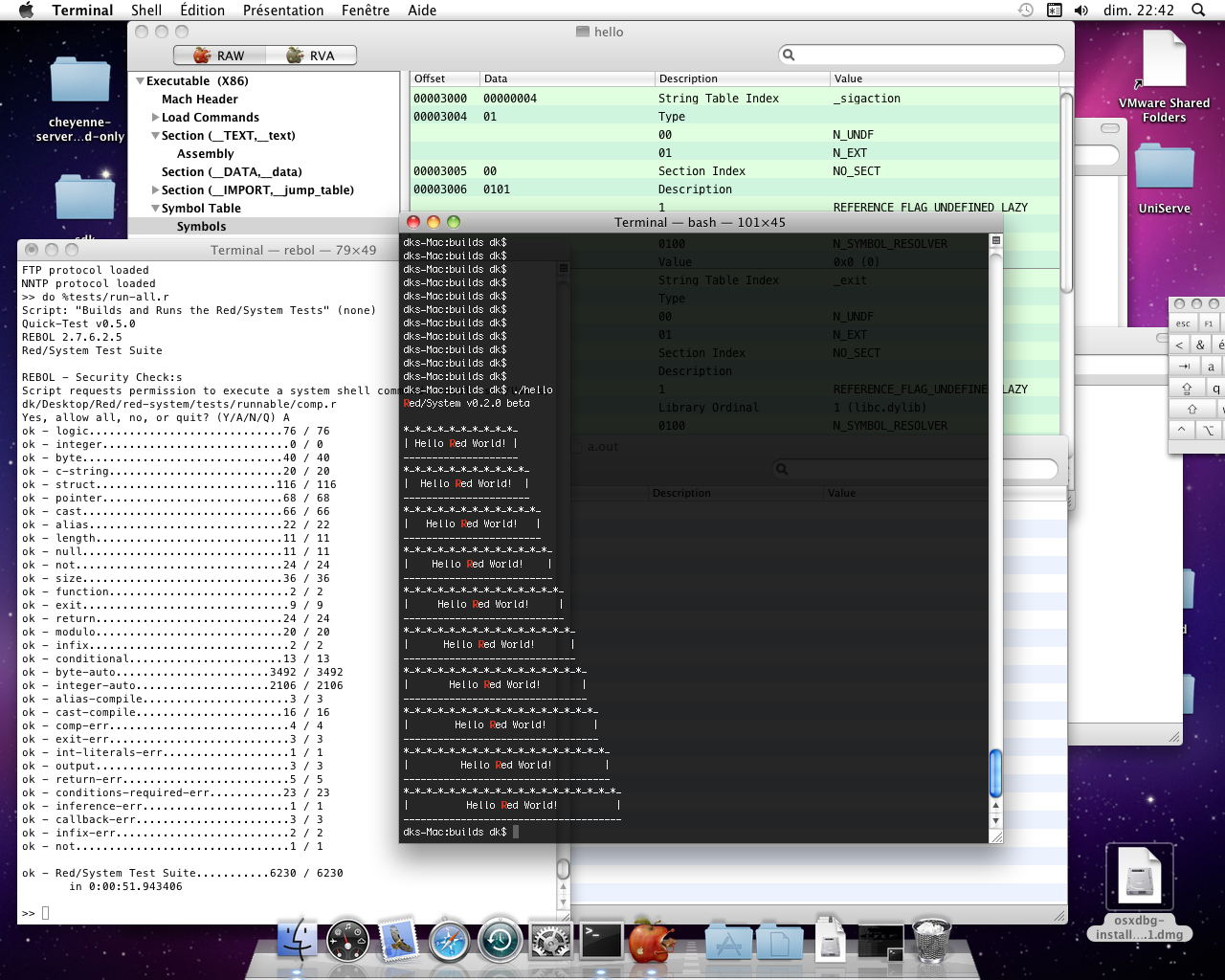
After a lot of efforts spent mostly in debugging, here is the result:


As you can see, it is fully functional and all unit tests are passing!

A couple of notes about usage:
  • The library you declare in #import definition needs to be located in /usr/lib/ or else, you need to provide a full path to the library.
  • The file emitter should support up to 255 imported libraries (Mach-O limit), but it has been tested only with one so far (libc.dylib), so if you have anything odd happening with more than one imported library, please fill a bug report in github's tracker, or post a message to the mailing-list.
Enjoy!
Fork me on GitHub