February 17, 2012

Floating point support released


New Red/System version 0.2.4 is out. The main new feature is floating point numbers support. This feature was not planned, but as users were strongly pushing for having it now, we have added partial support for floats. Users can now wrap and use libraries like OpenGL.

New floating point datatypes

Two new IEEE-754 datatypes were added:

  • float64! datatype implements double precision (64-bit) floating point numbers. It has an alias named float! which is the preferred name (both will be accepted by the compiler anyway).
They are first-class datatypes, so they can be used anywhere, as variables, arguments or returned values.

Float operations

Basic math and comparison operations are supported. Transcendental functions are not predefined yet in the runtime, they need to be imported first from an external library. For equality test, no rounding is applied, so only exact float numbers match will return `true`. Adding an "almost-equal" operator is planned, but not available yet.

Also, type casting is allowed between:

  • float! <=> float32!
  • float32! <=> integer!

Remember to type cast all float32! values to float! when passing them as argument to C variadic functions. For non-variadic C functions, Red/System's compiler will promote float32! to float! automatically.

Limitations

Not all of IEEE-754 standard was implemented yet. See the remaining features to add in this todo-list.

Implementation

At low-level, floating point support is architecture-specific:

  • IA-32: currently uses x87 FPU instructions for backward compatibility with older Intel CPU. The default implementation requires a PentiumPro or better. SSE unit support will be added when a proper optimizing compiler will be available. For older CPU support, a new compilation option has been added (`cpu-version`), which triggers the use of older opcodes. For example, in order to use floats on older than PentiumPro CPU, you need to add this line in the target definition:   cpu-version: 5.0
  • ARM: uses the VFP unit when available and was reported to run fine on emulated VFP. When calling some C functions passing or returning float numbers, some ABI mismatching were also reported during the tests, as ARM uses different ABI for passing float numbers as arguments. Our current implementation only use the passing-on-stack convention, adding support for other conventions is not planned, but will be done when really required.
Tests coverage extended

Several thousands new tests were added to the test suite, pushing the total number of unit tests to 11755. Thanks to Peter for taking care of that.

Decimal support

As IEEE-754 2008 revision introduced several new decimal floating point formats, we plan to support them later in Red/System.

Other feature released: enumeration support

A contributed feature is also part of this new version of Red/System: C-like enumeration support. This contribution was brought by the lead developer of Amanita Design, small independent game developing studio based in Czech Republic, which released the award-winning game Machinarium. A new compilation directive was added to declare enumerations: #enum.

Last but not least...

We got noticed by Ruby's author, Matz, he tweeted about Red! :-)

December 26, 2011

ARM support released

We are pleased to announce that Red/System v0.2.3 is out, extending Red to the mobile world with a complete support for Linux on ARMv5+ processors. The new port supports 100% of Red/System features and passes successfully the 8537 unit tests.

For those of you interested in more details, our ARM port targets the v5 family, with 32-bit instructions (no Thumb support) and optional literals pools (use -l or --literal-pool command-line option when compiling) that implement a global allocation strategy (unlike gcc's function-local allocations).

New compilation targets have been provided for Linux and derivative OS running on ARM:

  • Linux-ARM
  • Android

Android support is using the same code as Linux-ARM, only differing in libc and dynamic linker names.

Currently, as Red/System only works on command-line in Android, you need a special loader to download the executable and run it. This can be achieved using the NativeExe appYou will need to allow temporary installing apps from non market sources (Settings > Applications > Unknown sources). Also, your local 3G provider might be filtering out executables downloaded this way, you can workaround that by either manually loading the NativeExe-0.2.apk file with adb, or share a wired Internet connection with your mobile device.

You can easily install NativeExe app by just typing the following URL in your Android web browser:

http://gimite.net/archive/NativeExe-0.2.apk

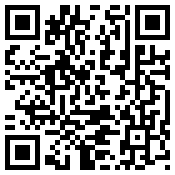
or by scanning this QR-code instead:

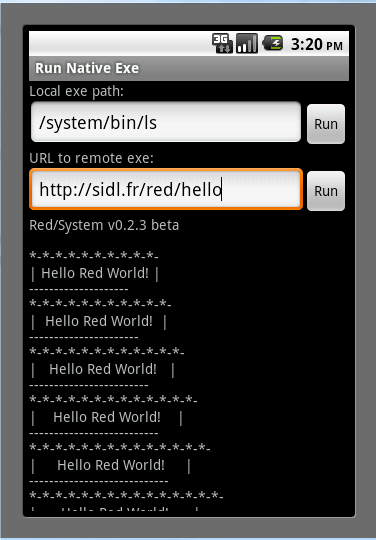
Once done, input in the second field: http://sidl.fr/red/hello and hit [Run]. 


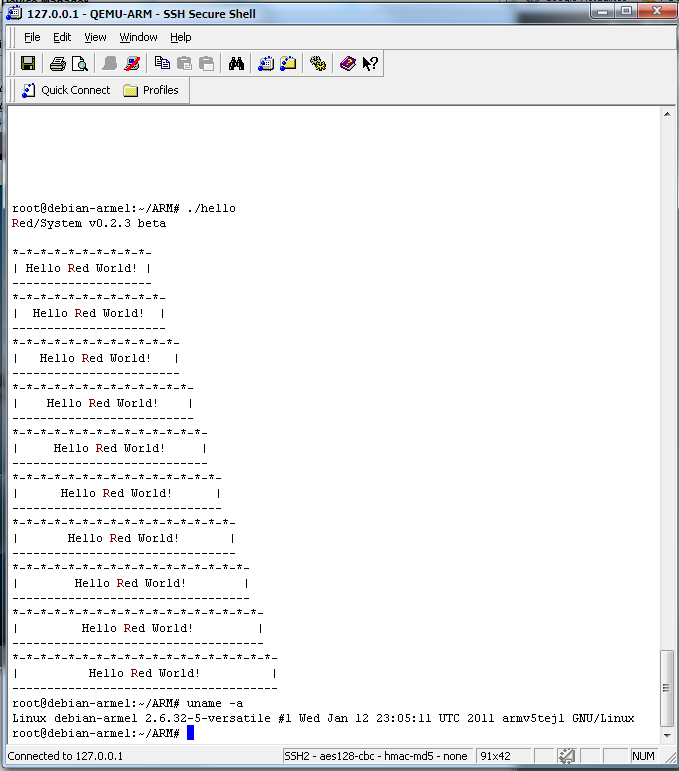
Here are a few screenshots of HelloWorld tests:

hello.reds script on Android 2.2

hello.reds script on Linux Debian 6.0 in QEMU


Andreas has also reported that it's working fine on Nokia N9 devices.


Supporting Android and iOS API

The next steps to enable building full apps on Android and iOS are:

  1. Support PIC compilation mode: indirect access to all global variables and data. This is a requirement for building shared libraries on UNIX (but optional on Windows).
  2. Add shared library generation to file format emitters. This will require some new compilation directives to mark the exported code parts.
  3. Build a bridge with Java for Android and Objective-C for iOS/OSX. This generic bridge would allow accessing all the objects and methods of the host and send back to Red all I/O events.

Such approach will allow us to build easily Android or iOS apps without having to write a single line of Java or Objective-C code, while providing the full power of  Red. At least, that's the theory, we'll see in practice if it's up to our expectations. Also, cross-compilation should be fully available for Android (producing Android apps from any OS), but code signing and app publishing requirements might make it impossible for iOS and require a MacOS X with Xcode for producing apps (if you know workarounds, let us know).

The PIC support should be doable in a few days, the support for shared library generation might take a bit more time. Anyway, theses tasks will need to be multiplexed with Red runtime & compiler implementation, so don't expect significant progress before a month.

In the meantime, you are welcome to test the ARM port of Red/System and hack Android and upcoming Raspberry Pi devices using it. ;-)

Cheers!

September 21, 2011

Red/System v0.2.2 released

This release is mainly a bugfix release that solves several old issues. It is also now correctly synchronized with all the current bindings done for Red/System. The main changes are:
  • Internal compiler refactoring of: expressions compilation, type casting and ANY/ALL support.
  • Greatly improved runtime error reporting: now it reports both source line number and source file name where the error occured. It works in debug mode only (-g command-line option).
  • Aliased struct names can now be tested separately in typed (RTTI) functions.
  • Callback function attribute removed. It is no more needed and any function can now be used as a callback. In addition a new cdecl attribute is now accepted to allow the switch to C calling convention, when passing a function as argument to an imported C function.
  • 21 issue reports closed.
  • More than 2000 new unit tests were added (mostly generated using scripts wrote by Peter WA Wood) for a total of now 8613 tests.

September 20, 2011

Red at Software Freedom Day 2011

I have been invited at the Software Freedom Day 2011 (September 14th) to give a talk about Red. Here are the presentation slides and the video.


If you are experiencing issues seeing the slides in flash format, here's a PDF version.


I am not a great speaker, so you might want to go through the slides first, and eventually have a look at my corresponding comments in the video (it is too long anyway). I need to make shorter and faster presentations in the future.

August 10, 2011

Red/System v0.2.1 released

This new release is bringing a lot of important bug fixes and some new features for Red/System. The new PRINT function might break some existing scripts, but should be easily fixable.

New features
  • Variable-arguments function support
  • RTTI function limited support
  • Polymorphic and variadic PRINT function
  • Command-line arguments access
  • Added stack low-level manipulation native functions: push, pop
  • Access to stack pointer and stack frame pointer (reading/writing)
  • Subtracting two pointers is now possible
  • Preprocessor improved to solve macros recursively
  • New built-in hexdump debugging functions
  • External library access unit tests (thanks to Peter)
PRINT function examples:

print 123
123

print "hello"
hello

print [123 "hello"]
123hello

print [123 tab "hello" lf "world" lf]
123 hello
world

a: 1 < 2
b: "hello"
print [a tab b/2]
true e

Bugfixes
  • Complex arithmetic expressions involving pointers, path access and type casting are now much more reliable. 89 new unit tests were written to help fix the bugs and track regressions.

Specification document
  • Updated to match all new and changed features

Red runtime
  • Memory allocator implemented in Red/System, documentation is pending.

As you can see, no vacation this summer for Red project!

July 17, 2011

Mac OS X port released!

Red/System Mac OS X port is now completed and on par with Windows and Linux ports. The new Mach-O file emitter supports all current Red/System's features including #syscall and #import directives.

Now that all major 3 OS are supported, I can say that the Mac OS X file ABI and function call ABI are really the most complicated one to support from scratch, the Windows one (PE/COFF) being the simplest (with its own set of oddities, but simpler) and Linux's ELF somewhere in between. Among the issues we had to identify and deal with:
  • Stack alignment on 16 bytes constraint at the point of every library call (meet with the infamous "gate keeper" code causing segfaults and bus errors on misaligned calls)
  • Working around dynamically linked libraries info extraction that need to be copied from each library header to the generated executable image. This could have prevented cross-compilation.
  • The need for direct CALL opcode in the generated IA-32 code instead of indirect ones used for PE and ELF library function callings.

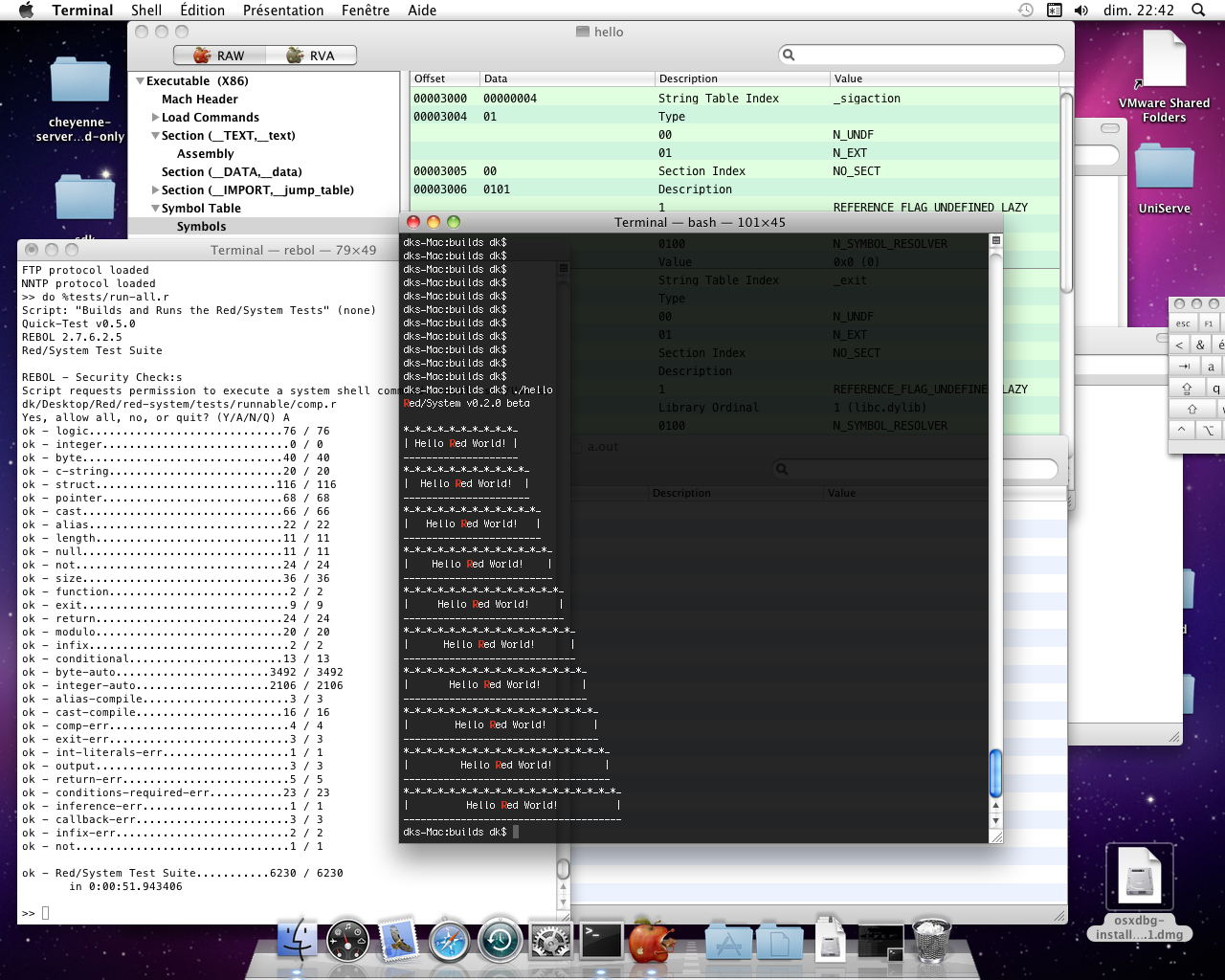
After a lot of efforts spent mostly in debugging, here is the result:


As you can see, it is fully functional and all unit tests are passing!

A couple of notes about usage:
  • The library you declare in #import definition needs to be located in /usr/lib/ or else, you need to provide a full path to the library.
  • The file emitter should support up to 255 imported libraries (Mach-O limit), but it has been tested only with one so far (libc.dylib), so if you have anything odd happening with more than one imported library, please fill a bug report in github's tracker, or post a message to the mailing-list.
Enjoy!

July 4, 2011

Red/System goes beta!

This is a major milestone reached on the Red roadmap. Red/System is now in a beta state, which means that it is good enough, both in design and implementation to be used for building applications.

A huge collective effort has been made by all contributors to reach that state during June, in a single month, we produced:
  • 190 new commits (total = 354 now), more in a month than in the three previous ones!
  • 3600 more unit tests (total = 6230 now)
  • 2800 more LOC (total ~ 6000 LOC now)
  • 70 issues closed on github's tracker
  • 8 more revisions of specification document
This is what can be called an "intense" month of work!

There are still a lot of features that are lurking in the corner for inclusion. Red/System features are not set in stone, the language will evolve to match our needs, as a support tool for building Red. It will now follow a bit more organized release cycle to help users and contributors have a more stable base to work with.

The version number has been bumped to v0.2.0. From now on, only non-disruptive changes will be pushed on the main branch, other changes will go into a separate development branch until we decide to make a new release, merge new features and increment the version number. This cycle should be short, on a weekly basis (each week or two, depending on the development branch content). If this organization does not fit well the development progress, we will adapt to a more adequate one.

I cannot resist to show you the new unit testing output when running the complete tests suite (just run the %tests/run-all.r script):

Quick-Test v0.5.0
REBOL 2.7.6.3.1
Red/System Test Suite

ok - logic.............................76 / 76
ok - integer............................0 / 0
ok - byte..............................40 / 40
ok - c-string..........................20 / 20
ok - struct...........................116 / 116
ok - pointer...........................68 / 68
ok - cast..............................66 / 66
ok - alias.............................22 / 22
ok - length............................11 / 11
ok - null..............................11 / 11
ok - not...............................24 / 24
ok - size..............................36 / 36
ok - function...........................2 / 2
ok - exit...............................9 / 9
ok - return............................24 / 24
ok - modulo............................20 / 20
ok - infix..............................2 / 2
ok - conditional.......................13 / 13
ok - byte-auto.......................3492 / 3492
ok - integer-auto....................2106 / 2106
ok - alias-compile......................3 / 3
ok - cast-compile......................16 / 16
ok - comp-err...........................4 / 4
ok - exit-err...........................3 / 3
ok - int-literals-err...................1 / 1
ok - output.............................3 / 3
ok - return-err.........................5 / 5
ok - conditions-required-err...........23 / 23
ok - inference-err......................1 / 1
ok - callback-err.......................3 / 3
ok - infix-err..........................2 / 2
ok - not................................1 / 1

ok - Red/System Test Suite...........6230 / 6230
in 0:00:16.3

A big thank to all the following contributors who are working hard each day to help me bring Red to life:

Andreas Bolka
Rudolf W.Meijer
Kaj de Vos
Peter W A Wood

Cheers!

EDIT: for those coming here for the first time and willing to test Red/System, please follow the link to Github's repository, you will find some instructions there for getting started.
Fork me on GitHub